Overview
At a glance
Is this game right for my group?
ABG editorial scores on a 1–5 scale.
Harder to teach
High replayability
Highly interactive
Scales well
Deep strategy
More strategic control
How it plays
How does it play?
Build a Mesopotamian civilization from double-sided tiles, spending action points to expand districts, exchange terrain, specialize regions, and score prestige.
Core mechanisms
Key systems that shape the decisions players make.
Action Points
Spend a limited allowance of points across several possible actions each turn.
Tile Placement
Place tiles to build a shared or personal spatial arrangement.
Set Collection
Gather related items that become more valuable when scored together.
Enclosure
Surround spaces or pieces to claim territory, capture, or score.
Modular Board
Build the play area from interchangeable sections that vary between games.
Read the full game description
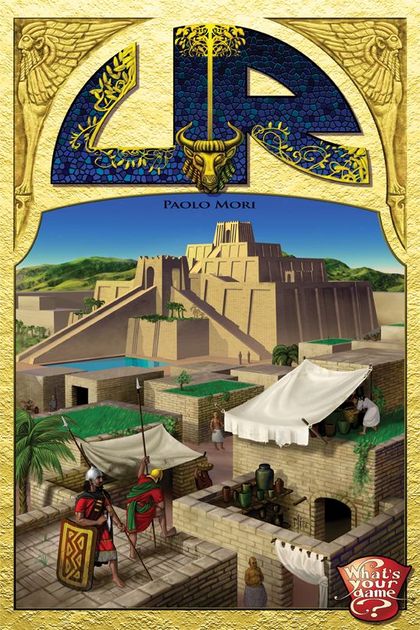
Ur is Paolo Mori’s tile-laying civilization game set in ancient Mesopotamia. Players build a shared landscape from double-sided terrain tiles representing agriculture, commerce, culture, politics, and warfare. Each turn provides action points to place, exchange, or influence tiles, letting a player reshape boundaries and strengthen connected regions while opponents pursue competing patterns on the same modular board. The five civilization aspects score in different ways, so a prosperous position needs both spatial planning and timely specialization rather than indiscriminate expansion. Set collection and enclosure incentives reward coherent districts, but every exchange may improve a rival’s route or deny a needed terrain type. The result is an abstract, interactive civilization contest: thematically broad, mechanically precise, and compact enough to reveal its strategic arc in under an hour.