Overview
At a glance
Is this game right for my group?
ABG editorial scores on a 1–5 scale.
Harder to teach
High replayability
Highly interactive
Scales well
Deep strategy
More strategic control
How it plays
How does it play?
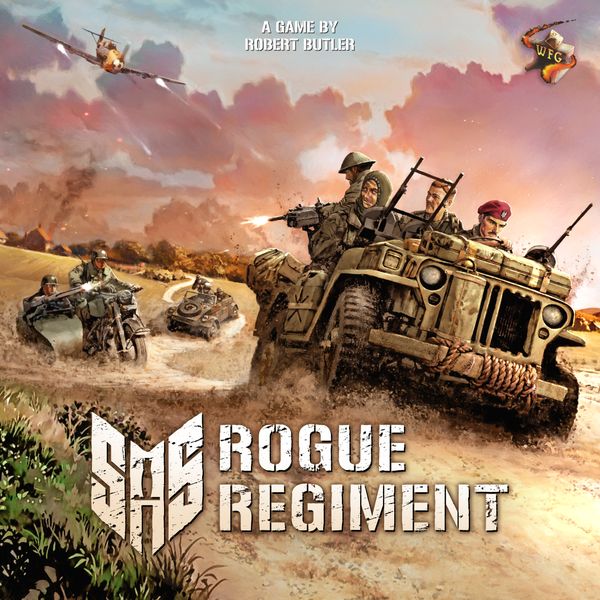
Lead an SAS team behind enemy lines, spend four actions per operator, sabotage Axis targets, and escape before stealth becomes a firefight.
Core mechanisms
Key systems that shape the decisions players make.
Action Points
Spend a limited allowance of points across several possible actions each turn.
Cooperative Game
Players coordinate their actions toward a shared objective and win or lose together.
Grid Movement
Move pieces between adjacent spaces on a regular grid.
Dice Rolling
Roll dice to introduce uncertainty into actions, production, movement, or resolution.
Action / Event
Use Action / Event as a recurring structure for player decisions and resolution.
Read the full game description
SAS: Rogue Regiment is a solo or cooperative World War II stealth-action game set in the weeks after D-Day. Players control a small team of named operators moving across modular square-grid maps to ambush convoys, destroy equipment, assassinate officers, rescue allies, and complete other sabotage missions. Each operator receives four action points for movement, attacks, equipment, posture, and mission tasks. Axis sentries follow patrol lines and event instructions until suspicious activity raises alert levels; gunfire, exposed bodies, delay, and poor positioning push the stealth meter toward a full alarm. Once detected, the system shifts into a more dangerous battle section in which the outnumbered team must finish quickly or withdraw. Equipment, vehicles, traps, explosives, and asymmetric operator tools reward planning, but dice and event cards keep enemy behavior uncertain. Missions form a campaign while also functioning as tactical scenarios, and scalable operator counts let one player command the whole unit or several players share decisions.