Overview
At a glance
Is this game right for my group?
ABG editorial scores on a 1–5 scale.
Easier to teach
High replayability
Low interaction
Scales well
Deep strategy
More strategic control
How it plays
How does it play?
Build upward with double-hex tiles, extend matching color lines, and protect the weakest score that ultimately decides the winner.
Core mechanisms
Key systems that shape the decisions players make.
Tile Placement
Place tiles to build a shared or personal spatial arrangement.
Hand Management
Time and sequence a limited hand of cards to preserve future options.
Pattern Building
Place elements to create arrangements that satisfy scoring or action patterns.
Highest-Lowest Scoring
Final scoring depends on balancing categories because the highest or lowest value matters.
Layering
Place components over earlier pieces so their order and overlap affect play.
Team-Based Game
Players compete in fixed teams and coordinate toward a shared team result.
Read the full game description
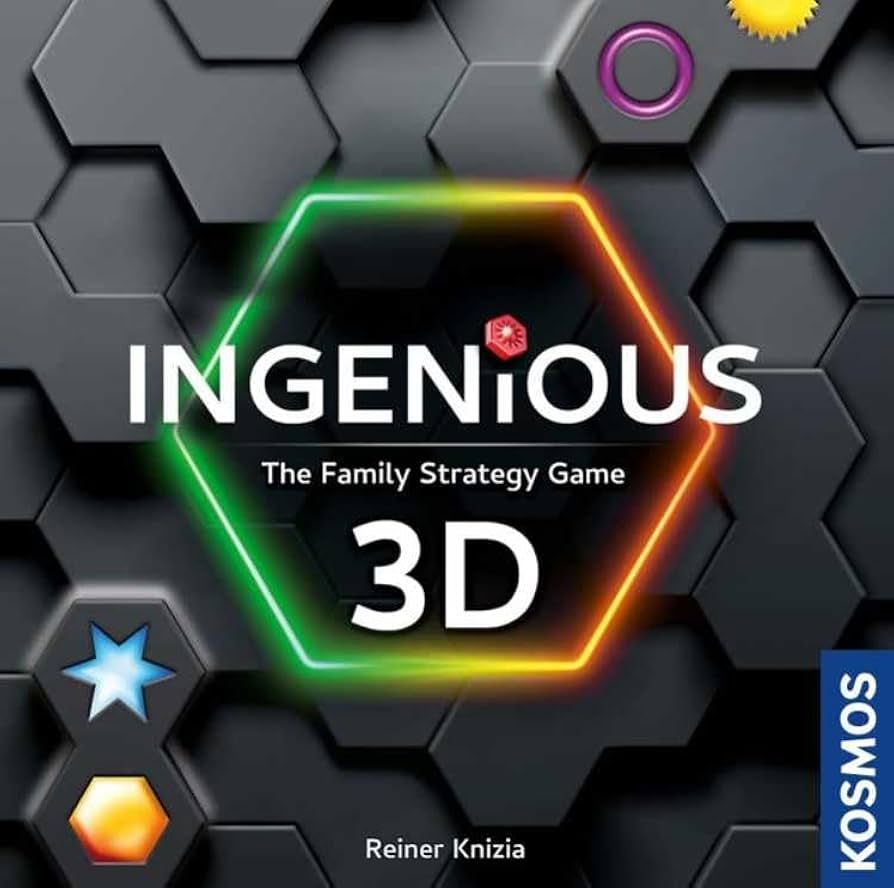
Ingenious 3D lifts Reiner Knizia’s lowest-score-wins classic into a tactile landscape of stacked hexagonal tiles. On each turn, players place one double tile either on the board or on top of a supported pair, then score each half by tracing straight lines of matching symbols. New levels expose fresh connections while also covering spaces and changing which routes remain available. Every color matters because the player’s final result is their lowest color score, so spectacular gains in one track cannot rescue a neglected one. The puzzle works competitively, in teams, or solo, with compact turns and a board state that becomes more constrained—and more three-dimensional—with every placement.