Overview
At a glance
Is this game right for my group?
ABG editorial scores on a 1–5 scale.
Harder to teach
High replayability
Highly interactive
Scales well
Deep strategy
More strategic control
How it plays
How does it play?
Run a plant cell through sunrise, daytime, and evening, convert water and carbon dioxide into carbohydrates, and build the strongest cell wall.
Core mechanisms
Key systems that shape the decisions players make.
Area Majority
Compete to have the strongest presence in areas that award control or points.
Worker Placement
Commit limited workers to action spaces before opponents occupy them.
Tech Progression
Unlock or improve abilities by progressing through connected development paths.
Set Collection
Gather related items that become more valuable when scored together.
Read the full game description
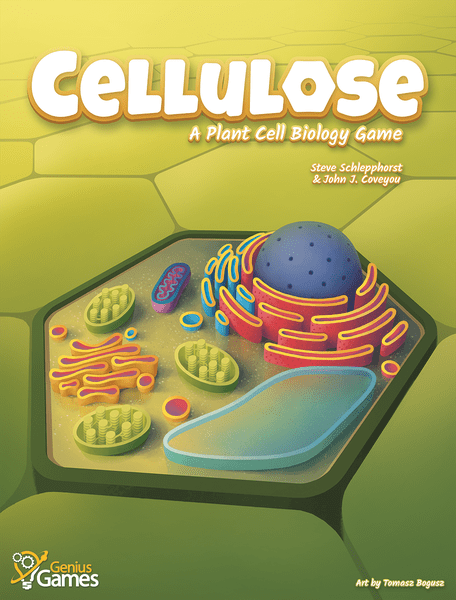
Cellulose: A Plant Cell Biology Game is a worker-placement strategy game set inside a plant cell. Each round represents a day divided into sunrise, daytime, and evening. Players gather water and carbon dioxide, claim limited cell-board actions, perform photosynthesis to create carbohydrates, and convert those carbohydrates into cellulose for the shared cell wall. Hormone tracks, proteins, enzymes, organelles, and cell-component cards turn real biological processes into an interconnected resource engine. Contributing water to the central vacuole creates an area-majority contest, while specialization cards and developing cellular functions open distinct scoring paths. Timing matters because every player needs many of the same action spaces and resources; an efficient sequence can produce extra actions, while a blocked pathway can stall the entire round. A responsive automa supports solo play, and the competitive game scales to five. The result is both a faithful teaching model and a substantial medium-weight game about turning sunlight, matter, and cellular machinery into growth.